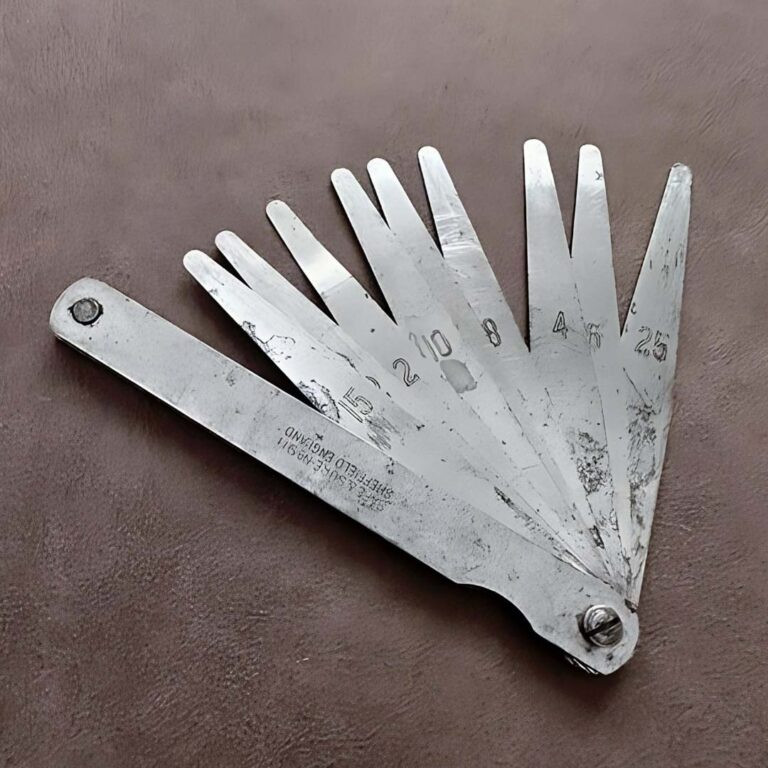
In the automotive industry: When a mechanic adjusts spark plug gaps or checks valve clearance on an engine, they use a feeler gauge. Its precision ensures optimal performance and a longer lifespan for components.
In industrial manufacturing: The perfect assembly of parts often depends on this small tool. A defect, even of a few micrometers, can compromise the quality of a product.
In precision mechanics: Engineers, whether working in design or maintenance, rely on the feeler gauge to verify that every mechanical component fits with surgical precision.
Ingenious design: simplicity in the service of precision.
An ingenious design: simplicity at the service of precision.
The thickness gauge, composed of calibrated metal strips, is based on a simple principle: a strip of the desired thickness is selected and slid into the area to be measured. In a matter of seconds, it provides an exceptionally accurate measurement. This combination of simplicity and reliability makes it indispensable, even with modern digital tools.
A legacy that transcends time.
Vintage tools that remain relevant.
Although digital gauges are becoming increasingly common, the design of classic thickness gauges remains unchanged. Collectors and enthusiasts of antique tools appreciate these instruments for their durability, craftsmanship, and historical value. Each set tells a story: that of an engineer or craftsman striving for perfection.
Continued on the next page